📚心得【Slow Gods】 by Claire North, 2025
#Space_Opera #氣候變遷 #難民問題 #文化變遷 #極端資本主義 #多性別
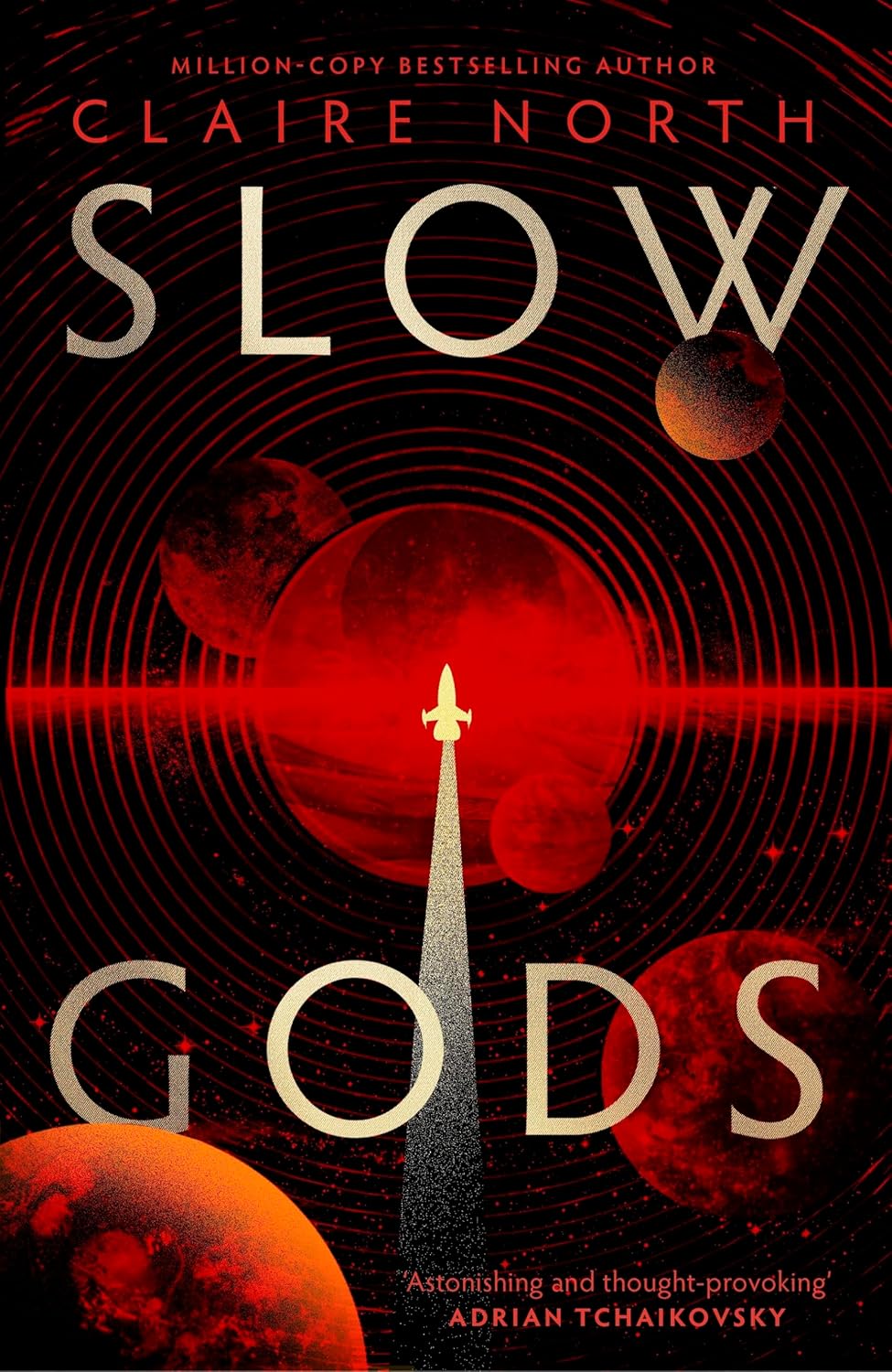
這本書在 Goodreads.com 上被網友拱進 2026 年的雨果獎請願名單,再加上封面上有我喜歡的大師 Adrian Tchaikovsky 的推薦。或許是是過度期待吧?讀完後我非常失望,甚至有些憤怒。
劇情上簡化來說,敘述一位在名為「Shine」的極端資本主義帝國下被榨乾殆盡、連腦袋都被去掉大半作為人機協同的蟲洞跳躍耗材(對,設定就是如此意義不明)的「奴隸」,因未知意外觀測到自己本體已死亡卻在另一處被重構,變得在特定情況下可以進入類似Minecraft的creative mode狀態。他能穿透物體、死而復生,甚至能變形成非人之物與無視物理規則,但這個外掛卻無法主動觸發;
"I remember just looking at the walls and thinking, goodness, that doesn't look very real, does it? All those atoms, and mostly just space between them, and it didn't occur to me that things that people took for granted - gravity, electromagnetism, the strong and weak nuclear forces - were important, somehow. So I walked out."
"They like to make sure I am observed. When no one is looking, that's when I forget what it is to be... acceptable. Normal. Part of this world."
與此同時,一個擁有巨大算力、與月球等大、因多次精準預言未來而被奉為神明的超級 AI「Slow」,發出了末日警告:百年後名為 Lhonoja 的行星將會相撞,83 光年內不會再有液態水與氣體存在,該區將化為毫無生機的焦土。
面對這場宇宙天災,故事展現了兩種極端的陣營:一邊是道義上互相幫助、相對理性安排撤離的「Accord 聯合」,他們面臨的不只是物理技術限制,還有撤離文明 Adjumir 文化失根與融合的痛苦;另一邊則是極端資本軍國主義的「Shine 帝國」,對內瘋狂壓榨等待死亡的窮困階層、對外主動侵略與統治弱小文明以求讓上層人士移居,甚至用藏匿在各星系的黑船武器威脅著整個星際,讓 Accord聯合敢怒不敢言。這是一個極度壓抑、壞人當道,且維穩成本高昂的殘酷世界。
不同於多數著重在硬科技或宏大敘事的太空歌劇,《Slow Gods》將核心對準了文明、外交、難民與天災下的政治角力,與在眾多凡人的宏大苦難面前,主角身處其中、不死不滅、卻無比在乎這些凡人的「神」,究竟有多麼無助?老實說,在過往的科幻作品中,我幾乎找不到類似的切入點,這也是本書最讓人驚艷的亮點。
然而,本書在畫面想像的容易度與沉浸感上卻給讀者築起了一道高牆。也許因為故事是透過主角那非正常的意識來敘述(我更相信是作者的問題),書中充斥著混亂的非線性時間跳躍、奇特的排版、清單式的章節,以及一套繁複的非生物與多性別代名詞系統(例如 AI 專用的 que/qis,以及外星種族的 xe/xer、te/ter),這迫使我放棄了畫面想像,只能把所有角色抽離成無性別的符號。這種實驗性的敘事手法極其勸退,Goodreads 上也有不少讀者因此直接 DNF(放棄閱讀),但作者甚至藉著書中角色之口,暗諷無法接受這套虛構代名詞的讀者。
How odd, the Adjumiris reply. You can remember the difference between innumerable different types of sausage or sporting teams, but you cannot hold in your mind a mere half-dozen or so categories of people? That must make navigating the nuances of human experience extraordinarily taxing for you.
我自己是覺得,人的腦容量是有限的,只會用來裝真正重要的東西;而這種疊床架屋的性別代名詞,顯然不值得耗費讀者的認知資源,我讀科幻是為了在符合現實物理規則下想像未來,而不是來讓本就難解的性別議題更複雜化。
在敘事上,主角回憶時展現出嚴重的日記化、贅述傾向,甚至連 bullet points 都出來了。最讓科幻迷難以接受的是,上面那些我用粗體紅字標出來的東西,都是前面章節埋下的設定,像是為何蟲洞跳躍一定得人機協同?跳躍時人們所描述的使人發狂的「黑暗」是什麼?主角為何在黑暗中被重構、複製後擁有了這些能力?我本以為這都是作者精心埋下的伏筆,結果直到結局作者也完全不打算解釋其運作原理,態度極其隨性、不負責。說實話,看完我整股氣都上來了,這還算是科幻嗎?所有的梗都讓讀者自己腦補啊?
事後查了 Claire North 的背景(原名 Catherine Webb,我查了才知道是位女作者。早自 2002 年起就以奇幻、虛構歷史與神話文學見長),我才恍然大悟,她不是第一次寫科幻,但根本也不是寫科幻的,開始讀這本書是我的錯。如果你期待的是嚴謹、有邏輯的太空歌劇,那在翻開這本書之前,請務必做好「這是一部有奇幻風格的社會學故事,不是本正統科幻小說」的心理準備。
#Space_Opera #Climate_Change #Refugee #Cultural_Changes #Hyper_Capitalism #Multi_Gender
This book was pushed by netizens onto the 2026 Hugo Award petition list on Goodreads.com, and to top it off, the cover featured a recommendation from my favorite author — Adrian Tchaikovsky. Perhaps my expectations were simply too high? After finishing it, I was deeply disappointed, a bit mad even.
To simplify the plot, it follows a "slave" who has been thoroughly drained under a hyper-capitalist empire named "Shine." Most of his brain has even been scooped out to serve as human-machine collaborative consumables for wormhole jumps (yes, the setting is just that nonsensical). Due to an unknown accident, others had witnessed his original body die while being reconstructed elsewhere, leaving him able to enter states akin to Minecraft’s "creative mode" under specific conditions. He can phase through solid objects, resurrect from death, and even shapeshift into non-human forms while defying the laws of physics — though this cheat-code state cannot be actively triggered.
"I remember just looking at the walls and thinking, goodness, that doesn't look very real, does it? All those atoms, and mostly just space between them, and it didn't occur to me that things that people took for granted - gravity, electromagnetism, the strong and weak nuclear forces - were important, somehow. So I walked out."
"They like to make sure I am observed. When no one is looking, that's when I forget what it is to be... acceptable. Normal. Part of this world."
Meanwhile, "Slow," a super AI with immense computing power, the size of the Moon, and revered as a god for its history of flawlessly predicting the future, issues a doomsday warning: a century from now, two stars named Lhonoja will collide. Within an 83-light-year radius, all liquid water and gas will cease to exist, turning the region into a lifeless, scorched wasteland.
Faced with this cosmic catastrophe, the story showcases two opposite factions. On one side is "The Accord," a coalition acting on moral mutual aid to rationally organize evacuations. They face not only physical and technical limitations, but also the agonizing cultural displacement and forced assimilation of the Adjumir civilization. On the other side is the hyper-capitalist militaristic "Shine" empire, which brutally exploits its impoverished underclass left behind to die, while aggressively invading and ruling weaker civilizations outside the disaster zone to relocate its elites. They even hold the galaxy hostage with stealth black ships armed with weapons scattered across various star systems, leaving The Accord frustrated but silent. It is a profoundly suffocating, cruel world where villains rule and the cost of maintaining stability is exorbitant.
Unlike most space operas that obsess over tech or epic scale, 《Slow Gods》 trains its lens on the geopolitical maneuvering of civilizations, diplomacy, refugees, and natural disasters. It explores just how utterly helpless a "god" — the immortal protagonist who walks among mortals and cares deeply about them — feels in the face of the grand, sweeping suffering of ordinary people. To be honest, I can barely recall any prior sci-fi work taking this exact angle, and it stands out as the book's most staggering highlight.
However, the book erects a massive wall against the reader's imagination and immersion. Perhaps because the story is told through the protagonist's abnormal copied consciousness (though I'm more inclined to believe it’s the author’s issue), the book is bloated with chaotic non-linear time jumps, bizarre formatting, and list-like chapters. It also forces a convoluted system of non-biological and multi-gender pronouns (such as "que/qis" for AI, and "xe/xer" or "te/ter" for different alien races). This compelled me to abandon visualizing the scenes altogether, reducing all characters to genderless, abstract symbols. This experimental narrative style is incredibly off-putting, leading many readers on Goodreads.com to DNF (Did Not Finish) the book outright. Yet, the author even goes so far as to use the one of the characters' mouth to snidely mock readers who struggle to accept these fictional pronouns.
How odd, the Adjumiris reply. You can remember the difference between innumerable different types of sausage or sporting teams, but you cannot hold in your mind a mere half-dozen or so categories of people? That must make navigating the nuances of human experience extraordinarily taxing for you.
Personally, I believe human brain capacity is limited, meant only to store what is important to each of us. This labyrinth of stacked gender pronouns is clearly not worth draining most of the readers' cognitive resources. I read science fiction to imagine the future within the bounds of real physical laws, not to have already complex gender politics made even more convoluted.
In terms of storytelling, the protagonist's recollections suffer from severe diary-fication and redundancy, to the point where actual bullet points show up. What sci-fi fans will find most unacceptable is that all those elements mentioned above — which should have been core sci-fi settings — are treated as discarded setups. Why must wormhole jumps require human-machine collaboration? What is the sanity-shattering "darkness" people describe during jumps? Why was the protagonist reconstructed and cloned inside this darkness, inheriting god-like abilities? I thought these were meticulously planned plot hooks; instead, the author doesn't bother explaining their mechanics at all by the end, maintaining an incredibly casual and irresponsible attitude. I was absolutely furious by the end. Does this even qualify as sci-fi? Are readers expected to just fill in every single blank with their own headcanon?
Looking into Claire North's background afterward, everything clicked. Her real name is Catherine Webb, and I only found out she was female after looking her up. She has been publishing works since 2002, primarily focusing on historical fiction, myth, and fantasy literature. This isn't her first attempt at sci-fi, but she fundamentally isn't a sci-fi writer. Starting this book was my mistake. If you are expecting a rigorous, logical space opera, make sure you brace yourself before opening this book: this is a fantasy-flavored sociological story, not a legitimate piece of science fiction.
IMO Rating: 48. It offers a sliver of novelty regarding refugees and cultural transformation, but at its core, it remains an incredibly sloppy, incomplete excuse for a sci-fi novel.
Core Theme: ★★★☆☆ (*5)
Plot Quality: ★★☆☆☆ (*4)
Character Development: ★★★☆☆ (*3)
Science Elements: ★★☆☆☆ (*3)
Ending Satisfaction: ★★☆☆☆ (*3)
Readability: ★★☆☆☆ (*2)


留言
張貼留言